Kin's Business Plan
How to read: this business plan is supplementary to Kin's open share offer, providing detailed projections and methodology.
Updated: 26.8.26. This page is best viewed on a desktop or in landscape.
Executive Summary
In two years Kin has grown to 215 active members contributing to more than 30 groups. Kin is in a strong position - the platform is already financially self-sustaining in its current form - but we are ambitious to make good on the enormous potential Kin has already demonstrated.
The facts:
- Kin is sustainable. Current member donations cover platform running costs. If the founding team continues to work on a volunteer basis, Kin can continue indefinitely.
- Kin is growing quickly. Membership has compounded 13.4% per month over the last six months - taken from Kin's live CRM data.
- Members value Kin. Average revenue per member is £1.27 per month, higher than the recommended minimum £1 per month donation - remarkably, this average holds above £1/month even though many members are on our £1-per-year solidarity tier.
This plan sets out how raising working capital through community shares can accelerate Kin's transition from a volunteer-sustainable platform to London Living Wage staff-sustainable co-operative with continued member and impact growth, while conservative projections show Kin remains solvent even as growth slows and per member revenue falls.
The ask:We are raising up to £300,000 over 3 years to create a strong social media presence, to fund the development of an app increasing usability and appeal, and developing place-based movements across the UK to reach the scale at which member donations fund a permanent team, turning a founder-dependent service into a resilient community finance institution. |
Traction: Kin's Story So Far
All figures in this section are drawn from Kin's live member and contribution records. The figures below are correct as of 26.8.26.
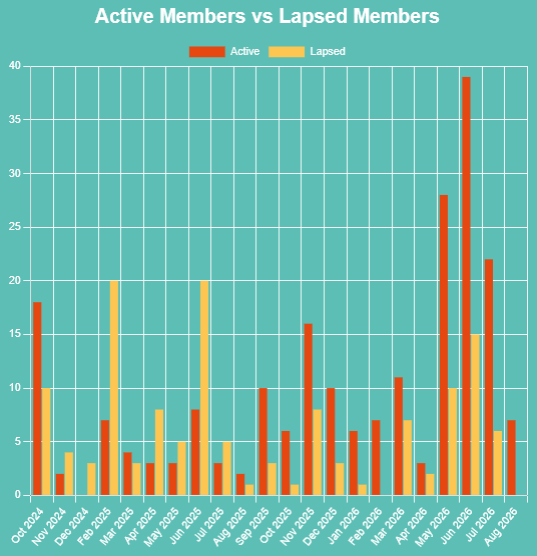
Membership
| Active members | 215 |
| Total Sign Ups | 350 |
| Lifetime churn | 38% |
| Member growth (CMGR) | 13.4% / mo |
Because our growth compounds, we express it as a Compound Monthly Growth Rate (CMGR), rather than a simple average, which would overstate the spikes (see graph).
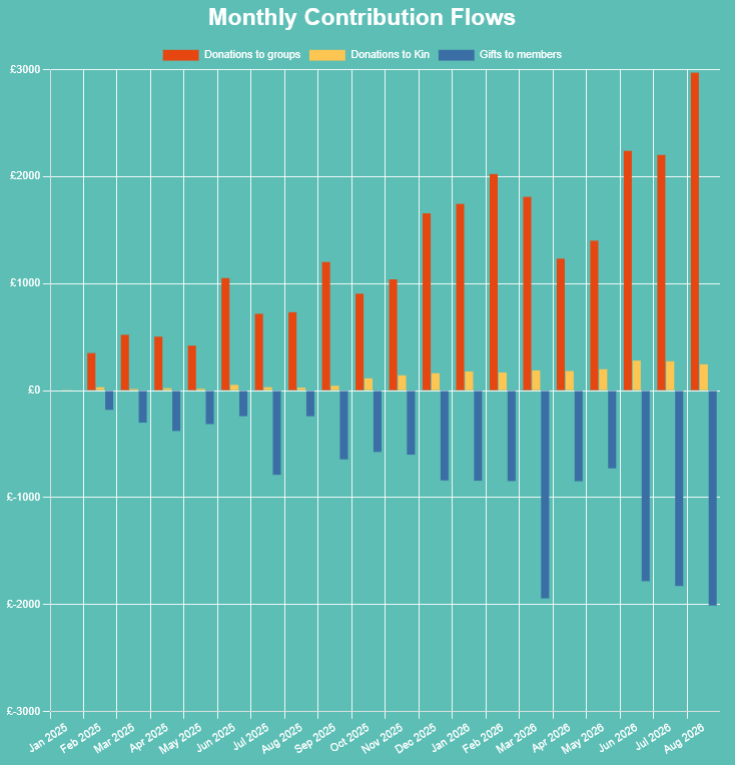
Money moving through Kin
| Member savings club contributions | £24,720 |
| Member returns from clubs | £15,916 |
| Savings club reserves (today) | £8,804 |
| Total donations to Kin | £2,382 |
| Total donations last month (Jul 26) | £273 |
| Donation revenue growth | 7.4% |
The graph shows real transactions, usually a high volume of small amounts £2-10, with group reserves demonstrating members trusting Kin to be a store of collective value over longer periods.
The economics works:
The cost to Kin per member is close to zero because the platform runs on open-source infrastructure and payment matching is mostly automated allowing for high transaction volumes with minimal additional labour time.
Therefore, with each member contributing an average of £1.27 per month:
- 199 members covers Kin's current running costs (hosting, memberships, accounting, contingency).
- 3,500 members covers a permanent two-person team at London Living Wage.
- Every additional member generates surplus that funds interest to shareholders and share buyback.
Capital Raise & Use
We are raising up to £300,000 through our Community Share Offer. Ideally, £25,000 per quarter over three years. The purpose of the raise is not survival but acceleration towards sustainability and resilience, and achieving our founding purpose.
Use of funds
| Core team (2 x 3 days/wk) | £48,000 /yr |
| App development | £25,000 (one off) |
| Running costs | £3,000 /yr |
| Reserves | Balance |
A previous grant covered two people working three days per week each for 6 months which led to Kin's fastest development and growth period. 3 years of funded core team labour with contingency for specific support around social media and app development would undoubtedly lead to sustained growth.
Reserves provide the runway to reach self-funding scale without risk of running out of cash.
Why raise if we are already sustainable?
Depending on volunteer labour is fragile. Today, Kin depends on two founders donating their time. Neither is in a position to give significant capacity indefinitely and there are legitimate ethical reasons for wanting to compensate their labour.
The raise does three things a volunteer model cannot:
- It buys speed. Scaling Kin membership to be self-funding in around two years rather than four or more.
- It buys resilience. Replacing volunteered time with a properly resourced team.
It buys otherwise unattainable projects and potential impact. Allowing for the development of a Kin app and greater movement-building capacity.
Financial Projections
We model three scenarios over three years. All share the same starting point (215 members, £1.27 average revenue per member) and the same current growth rate (13.4% per month). They differ in how many months that growth rate is sustained before decaying toward a conservative long-run floor rate (see below).
Projection Methodology
| Scenario | Content | Sustain (months) | Decay (months) | Floor rate |
| Zero raise | No investment. Volunteer only. | 2 | 8 | 5% |
| Middle | £150,000 raised. Core team funded only. | 9 | 12 | 6% |
| Fast | £300,000 raised. Core team plus app development. | 15 | 12 | 7% |
Membership Projection
| Scenario | Year 1 End | Year 2 End | Year 3 End |
| Zero raise | 564 | 1,012 | 1,818 |
| Middle | 843 | 2,195 | 4,416 |
| Fast | 857 | 3,266 | 7,578 |
Revenue Projection
| Scenario | Year 1 End | Year 2 End | Year 3 End |
| Zero raise | £6,011 | £11,965 | £21,487 |
| Middle | £7,154 | £23,715 | £49,844 |
| Fast | £7,177 | £30,290 | £81,695 |
Profit & Loss Projection
Annual operating position (revenue - operating costs and labour in middle and fast scenarios). The zero-raise scenario runs a modest surplus every year because it carries no salary costs. The funded scenarios run planned deficits (due to taking on share capital) while building membership, crossing into operating surplus as member donation revenue overtakes costs in month 31 (Middle) or month 24 (Fast).
| Scenario | Year 1 End | Year 2 End | Year 3 End |
| Zero raise | +£3,011 | +£8,965 | +£18,487 |
| Middle | -£43,846 | -£27,285 | -£1,156 |
| Fast | -£43,823 | -£20,710 | +£30,695 |
Cashflow & Share Buyback
Cashflow Projection
Cashflow combines operating position with share capital raised. In the Fast scenario, £25k is raised per quarter for 3 years. In the Middle scenario, half of that amount is raised at the same rate.
| Scenario | Year 1 End | Year 2 End | Year 3 End |
| Zero raise | £3,011 | £11,976 | £30,462 |
| Middle | £56,154 | £78,869 | £77,714 |
| Fast | £31,177 | £110,468 | £241,162 |
Share buyback and interest
Kin's share offer commits to build reserves and buy back member shares once Kin reaches operational stability and surplus. This is feasible:
- In the Fast scenario (£300k raise), Kin reaches operating surplus around month 24 and holds substantial reserves. Buyback and interest becomes feasible from Year 3.
- In the Middle scenario (£150k raise), Kin is self-funding around month 31 and holds a stable reserve of roughly £75,000. Buyback becomes feasible from Year 4 as surplus builds.
- In both funded scenarios the cash balance remains comfortably positive throughout, providing security for some member withdrawals.
Consistent with our share offer, we ask members to invest for a minimum term of three years. Our projections show this is the period over which the cooperative moves from investment to surplus, making orderly buyback possible from Year 3 onward.
Risk
The three projections above rest on two key assumptions: that growth broadly continues and that average revenue per member holds. We stress-test both.
Worst case scenario
We model a pessimistic case in which the full amount is raised (£300,000) but growth tapers soon and to a lower long-run rate (5% per month) and average revenue per member falls from £1.27 toward £1.10 as membership broadens toward the £1 floor. This is the single most likely adverse trend, since our data already shows membership growing faster than revenue.
| Measure | Outcome |
| Members at Year 3 end | 2,891 |
| Staffed self-funding | No / at reduced hours |
| Cash position | £175,144 |
| Kin remains solvent | Yes, throughout |
Key risks
| Risk | Mitigation |
| Growth slows sharply | The platform is already sustainable |
| Per member revenue falls | Co-operative remains solvent |
| Slower / more costly app delivery | App is non-critical to survival, additional funds can be raised or development paused |
| High share capital withdrawal | 3-year minimum term and strong cash reserves in all scenarios |
Critical assumption
Our current growth rate of 13.4% per month reflects a strong recent period from a low baseline and cannot continue indefinitely. We have therefore tapered growth toward conservative long-run rates in every scenario. The numbers presented are cautious.
Calculator
Scenario Calculator
The figures below are fixed. Adjust the variables in "Your scenario" to model different outcomes.
| Fixed inputs | |
| Starting membership | 215 |
| Current growth rate (monthly) | 13.4% |
| Annual running costs | £3000 |
| Staff cost (monthly, when funded) | £4000 |
| Target investment (over 3 yrs, quarterly) | £300000 |
| Your scenario | |
| Growth sustained (months) | |
| Decay period (months) | |
| Floor rate (monthly %) | |
| Avg revenue per member (£/mo) | |
| Investment (% of target) | % |
| Results | Y1 End | Y2 End | Y3 End |
| Membership | – | – | – |
| Revenue | – | – | – |
| Profit & Loss | – | – | – |
| Cashflow | – | – | – |
| Donation revenue overtakes costs in | – |
| All shares repayable by | – |
When the cumulative cash position rises above total share capital, the cooperative holds more reserves than members invested and share capital is repayable.